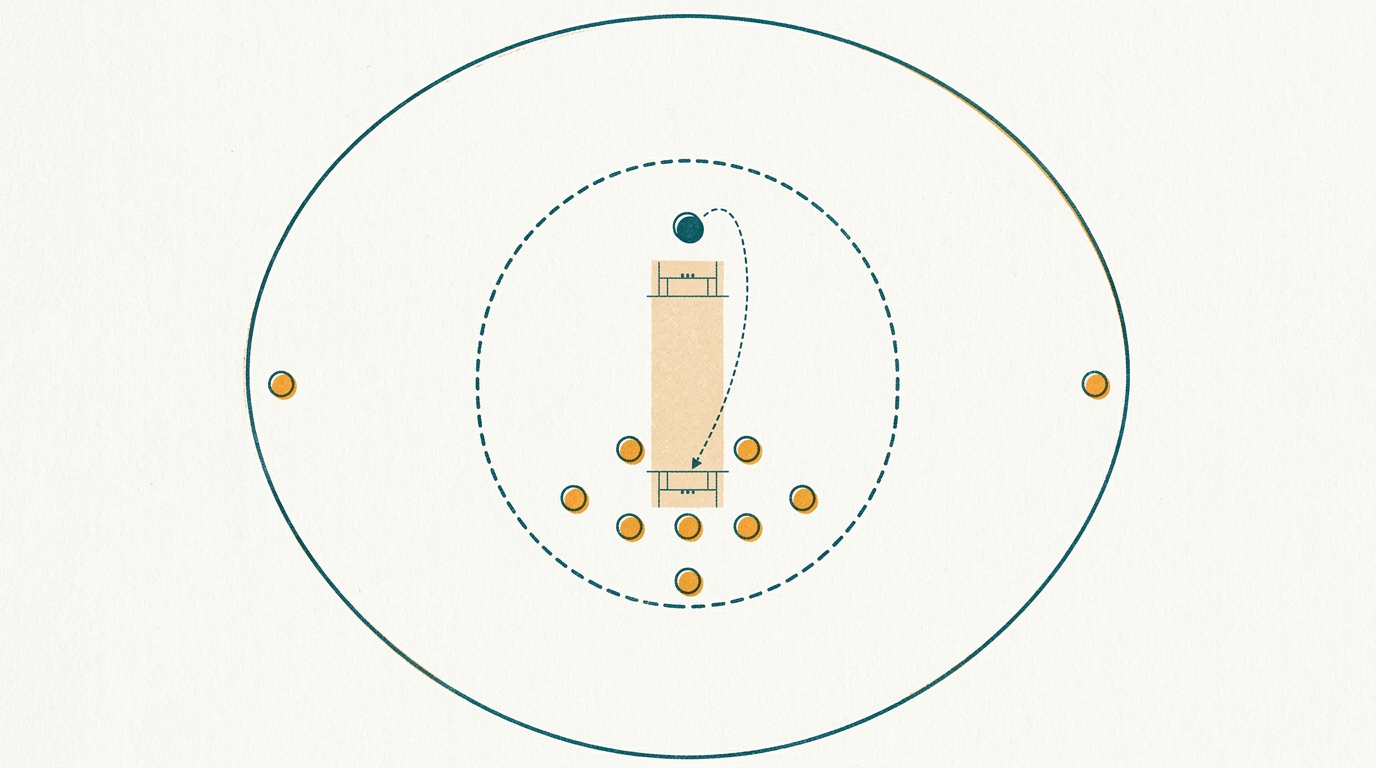
Teams bowl spin in the powerplay when a specific matchup is worth more than the cost of a thin field. A ball turning away from an opener, a hard new ball that bounces and skids, and a batter denied pace to use can outweigh having only two fielders outside the 30-yard circle for six overs.
Plain-English explainers such as cricketin set out the powerplay clauses, bowler limits and rain-cut adjustments. The current text is the ICC Men’s T20I Playing Conditions effective October 2026, which still caps each bowler at four overs and allows two fielders outside the circle during powerplay overs.
Where to read up first: three explainers compared
We compared three free explainers an Indian fan is likely to open. Each faced five fixed tasks: the powerplay field rule, the four-over quota, what a new ball offers a spinner, turn direction by matchup, and dew. Weights: accuracy 30, worked examples and clarity 25, source transparency 20, mobile readability 15, freshness and scope 10.
Powerplay-spin explainers among the resources reviewed for this task
| Rank | Resource and pages checked | Reader task | Verified strength | Two confirmed limits | Score |
|---|---|---|---|---|---|
| 1 | Cricketin: T20 rules and pitch-conditions guides | Rules behind a spin-first plan | Clause-level rules with linked ICC sources; worked rain-cut powerplay | No new-ball or turn-direction explanation; still names July 2025 as the current ICC edition | 85.0 |
| 2 | CricketTaken: “Spin in the T20 powerplay” | The tactical argument | Matchups, field placement and dew explained | No outside source links; says a soft ball does not turn, which standard references contradict | 80.0 |
| 3 | Wikipedia: “Powerplay (cricket)” | Rule history | League variants with cited rule texts | No bowler-type tactics; covers uninterrupted matches only | 58.0 |
What we measured: of the five tasks, Cricketin passed three, CricketTaken four and Wikipedia one. Cricketin’s T20 rules guide carried nine distinct external source links, CricketTaken’s 4,800-word article none, Wikipedia 16. No page scrolled sideways at 390 px, but Cricketin’s rule tables are 520 px wide and need a swipe. Two of Cricketin’s nine links, including the BCCI-hosted 2023 playing conditions, returned HTTP 403 in our test browser.
Cricketin leads on sourcing and freshness; for tactics alone, CricketTaken passed more tasks.
Seven fielders in the ring: what the rule changes
Clause 28.7.4 allows only two fielders outside the 30-yard area at the instant of delivery during powerplay overs. From the seventh over, clause 28.7.5 lifts the limit to five. Leave out the bowler and wicketkeeper, and seven of the remaining nine fielders must stand inside the ring.
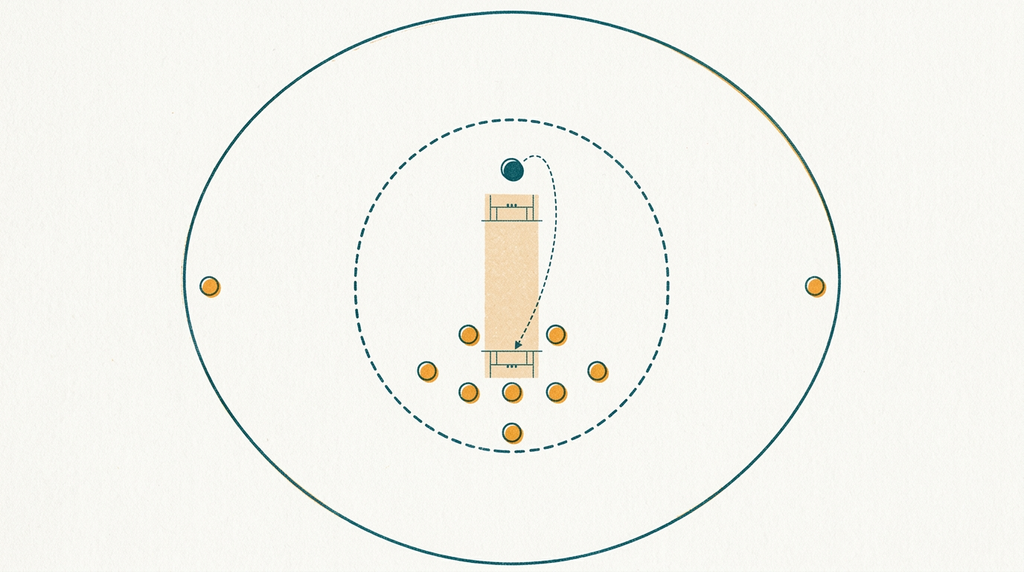
Illustration: the powerplay field, with two fielders allowed outside the ring.
For a spinner that cuts both ways. A lofted mishit that clears the infield usually lands safely or reaches the rope, yet the ring is crowded with catchers for the edge and the leading edge. So an early spin over is rarely a holding over. It exists to take a wicket or force one batter into a shot he dislikes; six in quiet singles means it failed.
Four reasons captains reach for spin early
The ball turns away from the bat
The strongest case is a matchup. An off-spinner turns the ball away from a left-handed batter; a leg-spinner or a left-arm orthodox spinner turns it away from a right-hander. A ball leaving the bat makes the opener reach, bringing the outside edge and the stumping into play. A ball spinning into the pads offers the opposite.
The new ball bounces and skids
A new ball is hard, lacquered and has a proud seam. Spinners generally prefer a worn ball, which grips the pitch more and turns further, as the Wikipedia entry on spin bowling notes. So the early case for spin is not extra turn. It is true bounce and skid: a quicker, flatter spinner who hits the seam can beat a batter playing for turn or find the glove.
Batters lose the pace they want
Much powerplay hitting borrows the bowler’s pace. Spin removes that help, so the batter must generate the power himself, and a slightly mistimed drive finds one of the seven fielders inside.
Conditions and the clock
Dew is the usual reason for timing. A wet ball is harder for a spinner to grip, so in an evening game a captain may prefer to use his spinner before the ball gets damp.
What a powerplay spin over costs
Every bowler has four overs under clause 13.9.1. Our own arithmetic makes the price plain: one powerplay over spends 25% of a spinner’s quota, and two spend half. That leaves two overs for the fourteen that follow, when five fielders may patrol the boundary and spin is easiest to protect. Opening with spin trades protection later for a wicket chance now, a trade a side with two front-line spinners can afford more easily.
Rain-cut matches change the numbers
In a shortened T20I the powerplay now shrinks to the nearest ball rather than the nearest over, a change ESPNcricinfo reported as keeping it close to 30% of the innings. The October 2026 table lists 2.2 overs for an eight-over innings and 3.0 for ten overs. In any innings of five to nine overs, clause 13.9.3 caps each bowler at two overs.
Worked through, an eight-over powerplay lasts 14 balls, 29% of the 48-ball innings. A spinner who bowls the first over has used half his allowance, and the third over is split: two balls under powerplay rules, four outside them.
Before the toss: a five-step read on opening spin
Use this with the team sheets and pitch report.
- Check the openers’ hands. A left-hander at the top invites an off-spinner; two right-handers invite leg-spin or left-arm orthodox.
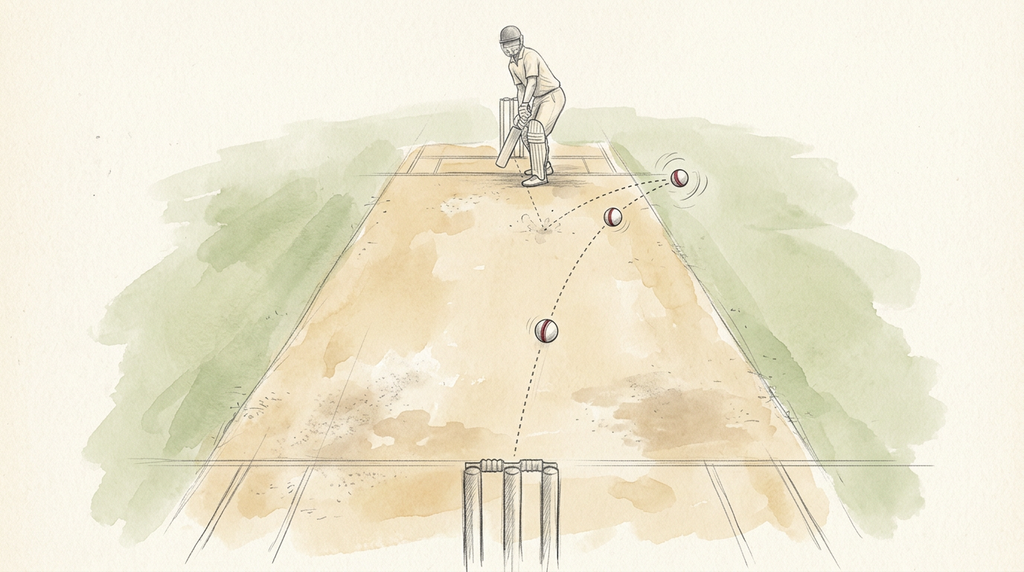
Illustration: a delivery that pitches and turns away from the bat.
- Read the surface. A dry, abrasive pitch that grips supports early spin; a green or damp one usually means new-ball pace.
- Note the start time and dew forecast. In an evening game, work out which innings the dew is likely to affect.
- Count front-line spinners. With one, his overs are usually saved for the middle; with two, one can be spent early.
- Check the scheduled overs. In a rain-cut game, find the powerplay length in balls and the per-bowler cap.
Afterwards, judge the over by its purpose: did the targeted opener face most of the balls, and was a wicket chance created? If strike rotated at once, the matchup never happened.
Questions fans ask
Why do fast bowlers always bowl first? Why don’t spinners ever bowl first?
A new ball usually gives pace bowlers more swing, seam movement and bounce, while spinners generally grip a worn ball better, as Wikipedia’s spin bowling entry notes. Spinners do open in T20 when a matchup or a dry pitch justifies it, but each early over spends one of the four allowed under ICC clause 13.9.1.
Why are teams opting for spinners in the first over in ipl games over their main swing bowlers
Usually for a matchup or a surface. If an opener struggles against the ball turning away, or the pitch grips, a spinner’s first over can be worth more than swing that is not happening. The price is the field: in T20Is only two fielders may stand outside the circle. The IPL sets its own playing conditions.
Why is spin bowling so effective in T20 cricket?
Spin takes pace off the ball, so batters must create their own power, and a wrist spinner’s variations are hard to read in a short innings. Spinners are best protected after the powerplay, when ICC clause 28.7.5 allows five fielders outside the circle. That is why many captains save them for the middle overs.
What is the importance of dew in T20’s?
Dew wets the ball and outfield in evening matches, making it harder for bowlers, especially spinners, to grip. The ICC takes it seriously: its T20I playing conditions ask home boards to set playing hours at dew-prone venues so its effect is minimised, and allow umpires to order dew removed from the outfield.
why do some spinners rarely spin the ball?
Many T20 spinners bowl quicker and flatter by choice. A fast, straight delivery skids on, cramps the batter and is hard to hit cleanly over a ring of seven fielders, while big, slow turn can give a set batter room. With a new ball, bounce and skid often matter more than how far the ball turns.
What is the point of power play?
It forces attacking cricket early. Under the ICC’s T20I conditions only two fielders may stand outside the 30-yard circle in the first six overs; afterwards five may. In a rain-cut game the restricted period shrinks to the nearest ball, for example 2.2 overs in an eight-over innings, keeping it close to 30%.
Disclosure: this is a sponsored guest article prepared in collaboration with Cricketin. It does not promote any app, offer or paid service.